 Email: ellie@autovistatx.com. Phone: 469-618-3976

Covid-19 Coronavirus
December 4, 2020
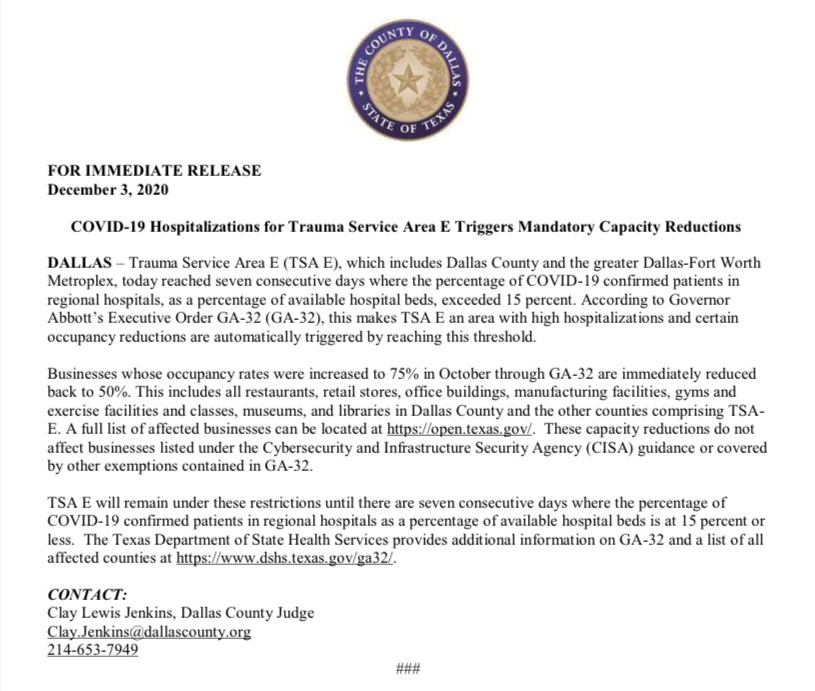
Roll Back: DFW Bars Close, Businesses Reduce Capacity as COVID-19 Hospitalizations Hit 7-Day Mark
An order issued by Gov. Greg Abbott (R) lays out a red line: When COVID-19 patients make up 15% or more of a hospital region’s capacity for seven straight days, a series of mandatory limits will activate with few exceptions.
When a TSA meets or exceeds 15% for seven consecutive days it is classified as a high hospitalization TSA. DSHS notifies county judges in the region of the following limits:
- Hospitals must suspend elective surgeries.
- Most businesses drop from 75% capacity to 50% capacity. This includes restaurants, retail stores, gyms, offices, museums, libraries, amusement parks, swimming pools, amusement parks, zoos, aquariums and similar facilities. All professional and college athletics events are already limited to 50% capacity. There are no capacity limits for a limited number of businesses including schools, religious services, and child-care services.
- Bars and other establishments with 51% alcohol sales must close. This overrides any previous exceptions allowing bars to operate at 50% capacity.
North Texas falls into seven different TSAs (pictured below). Just more than half of the counties in North Texas are grouped in TSA-E.

For Thursday December 3, the Texas Department of State Health Services reported TSA-E's percentage of COVID-19 patients was 15.56%. That number, while still above the 15% threshold outlined by the governor, has dropped for two straight-days from a high of 16.4% on Dec. 1.
When Will Restrictions Be Lifted?
Once a TSA spends a week at or above the 15% mark, restrictions will not be lifted until the TSA records seven straight days below the 15% mark.
October 14, 2020
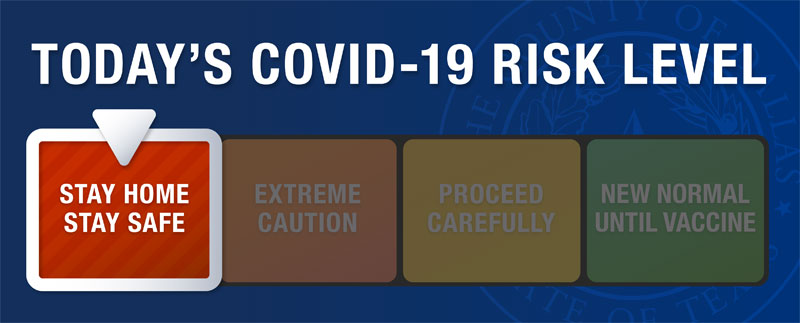
Dallas County Judge Clay Jenkins upped the COVID-19 risk level in the county on Wednesday.
The risk level went from orange for “Extreme Caution” to red for “Stay Home Stay Safe”.
“Today we see another high number of new COVID-19 cases with the numbers today being 454 confirmed cases and 50 probable cases for a total of 504 additional cases. The increase in hospitalizations, and new COVID-19 positive cases, as well as other metrics like the R-naught factor being above 1 for several weeks, has led the Public Health Committee to recommend a return to ‘Red’ on our color-coded chart. With a new and quickly escalating wave of COVID-19 cases hitting North Texas, it is more important than ever that we make good decisions,” said Dallas County Judge Clay Jenkins in a statement. “Things that doctors recommend as safe and permissible in ‘Orange,’ they recommend against in ‘Red.’ These things include dining in restaurants and personal grooming services, among other activities.”
Within hours of Gov. Greg Abbott’s announcement that most county judges may allow bars to operate at 50 percent capacity effective October 14, Dallas County Judge Clay Jenkins (D) indicated on social media that the county’s bars would indeed not be reopening.
“Regarding opening bars in Dallas County: I will not file to open them at this time. Below is the current guidance from the Public Health Committee and [the Dallas County Health and Human Services Department],” Jenkins tweeted on Wednesday afternoon. “We are in orange but our numbers are increasing (Badl) (sic). I will listen to everyone but will follow the science.”
Jenkins criticized Abbott on Monday after the governor suggested on social media that he would be relaxing COVID-19 rules.
“Unfortunately, we are now seeing an increase in daily new cases and hospitalizations in North Texas after the Governor increased occupancy limits in opened business,” Jenkins said.
This is not the first time the governor has lifted his bar closure mandate. Abbott moved to open bars in May, but then instructed that they close again in June.
Abbott’s handling of the COVID-19 pandemic has been criticized by both the left and the right.
“It’s becoming increasingly clear Texas will never open with [Abbott] as Governor,” Rep. Matt Rinaldi (R-Irving) said Wednesday on social media. “He has the same worldview as [California Gov. Gavin Newsome (D)], that Government has the ability to eliminate Covid through bureaucratic limitations on business & mask mandates, while ignoring harm.”
The Texas Bar and Nightclub Alliance also condemned Abbott’s announcement in a statement.
“We are extremely shocked by the announcement made today. When other Governors around the country, like Ron DeSantis, continue to lead and set a course for economic and social recovery for their states, today our Governor punted,” the statement read. “Texas bars and nightclubs are now the official scapegoat of the pandemic.”
NOW, THEREFORE, I, Greg Abbott, Governor of Texas, by virtue of the power and authority vested in me by the Constitution and laws of the State of Texas, and in accordance with guidance from the Commissioner of the Texas Department of State Health Services, Dr. John Hellerstedt, other medical advisors, the White House, and the CDC, do hereby order the following on a statewide basis effective at 12:01 a.m. on September 21, 2020:
Every business establishment in Texas shall operate at no more than 50 percent of the total listed occupancy of the establishment; provided, however, that:
1. There is no occupancy limit for the following:
a. any services listed by the U.S. Department of Homeland Security’s Cybersecurity and Infrastructure Security Agency (CISA) in its Guidance on the Essential Critical Infrastructure Workforce, Version 4.0 or any subsequent version;
b. religious services, including those conducted in churches, congregations, and houses of worship;
c. local government operations, including county and municipal governmental operations relating to licensing (including marriage licenses), permitting, recordation, and document-filing services, as determined by the local government;
d. child-care services;
e. youth camps, including but not limited to those defined as such under Chapter 141 of the Texas Health and Safety Code, and including all summer camps and other daytime and overnight camps for youths;
f. recreational sports programs for youths and adults;
g. any public or private schools, and any public or private institutions of higher education, not already covered above; and
h. drive-in concerts, movies, or similar events, under guidelines that facilitate appropriate social distancing, that generally require spectators to remain in their vehicles, and that minimize in-person contact between people who are not in the same household or vehicle.
2. The following types of business establishments may operate at up to 75 percent of the total listed occupancy of the establishment, except for those establishments in areas with high hospitalizations as defined below:
a. in-store, non-CISA retail establishments;
b. dine-in restaurants, as defined below in paragraph No. 7;
c. non-CISA office buildings;
d. non-CISA manufacturers;
e. museums and libraries; and
f. gyms and exercise facilities and classes.
Governor Abbott Issues Executive Order To Open Bars In Qualifying Counties
Governor Greg Abbott today issued an Executive Order to open bars and similar establishments at up to 50% capacity in conjunction with county officials. In hospital regions with low COVID-19 hospitalizations, County Judges will be able to opt their county into opening bars beginning October 14th, provided they assist in enforcing health protocols. The Governor's Executive Order also increases the occupancy levels for all business establishments other than bars to 75%.
Beginning Wednesday, October 14, all counties where COVID-19 hospitalizations are less than 15% of hospital capacity can open all businesses other than bars to 75% capacity.
Additionally, the Governor released a web video with his Executive Order, encouraging Texans to continue following best practices to mitigate the spread of COVID-19 in their communities.
- Fever or chills
- Cough
- Shortness of breath or difficulty breathing
- Fatigue
- Muscle or body aches
- Headache
- New loss of taste or smell
- Sore throat
- Congestion or runny nose
- Nausea or vomiting
- Diarrhea
- Trouble breathing
- Persistent pain or pressure in the chest
- New confusion
- Inability to wake or stay awake
- Bluish lips or face
- Stay in touch with your doctor. Call before you get medical care.
- Your local health authorities may give instructions on checking your symptoms and reporting information.
- Trouble breathing
- Persistent pain or pressure in the chest
- New confusion
- Inability to wake or stay awake
- Bluish lips or face